
Heritage Trees
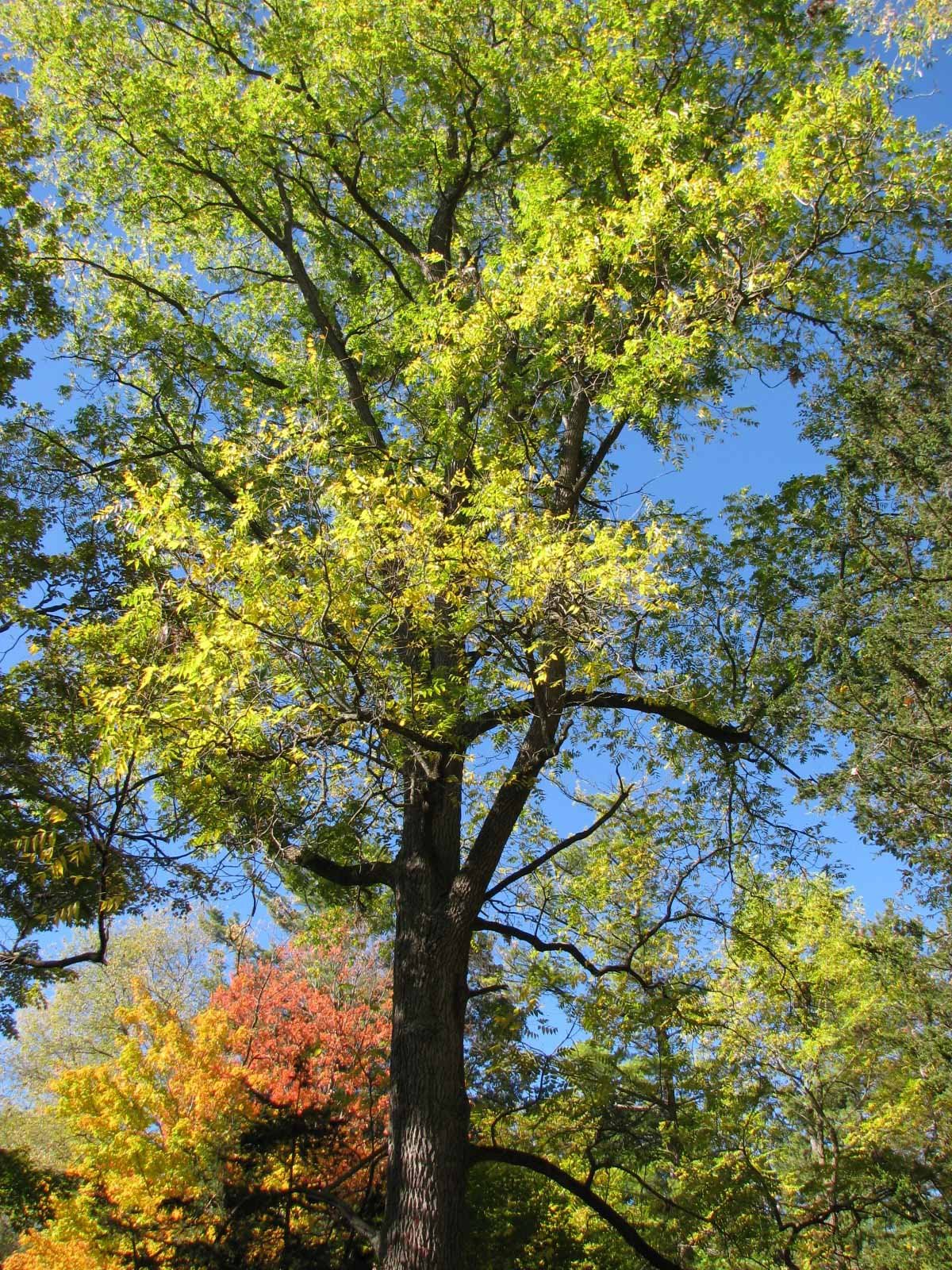
Join the movement to map our living history
Our heritage trees are more than just bark and leaves — they are the silent witnesses to our community’s history. It’s time to raise public awareness and truly value these giants. LEN has a mission to inform our neighbours and create a comprehensive inventory of heritage trees in our region.
Do you know of a heritage tree that should be in our inventory? Email us at lakeshoreeconetwork1@gmail.com to nominate a tree.
Why mature trees matter
At the heart of LEN’s mandate is the recognition that trees are vital to protecting biodiversity and fighting climate change.
Recognizing their value, many Canadian municipalities now include trees in their Asset Management Plans. Specimens of significant size, age or historical and cultural value are identified as Heritage Trees and protected.
What we look for
Lakeshore Eco-Network’s Heritage Tree Project has similar goals. We look for trees that have:
- Size and age: massive or ancient specimens
- Historical significance: trees connected to local heritage or culture
- Unique features: rare species or unusual growth patterns
Priority is given to trees indigenous to the region.
Please contact Lakeshore Eco-Network (lakeshoreeconetwork1@gmail.com) if you know of a tree that should be included.
Our heritage trees
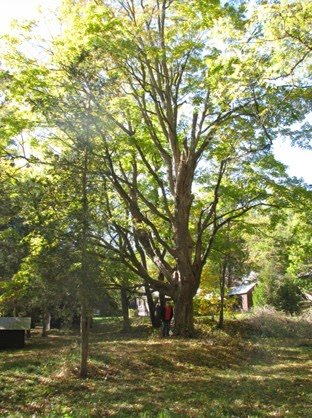
Sugar Maple at the Warner Preserve
Acer saccharum
- Where
- Warner Preserve (entry by invitation only)
43°17′50.36″N 81°45′50.50″W - Diameter
- 102 cm
- Age
- c.155 years, but could be older
- Lifetime carbon sequestration
- 14.15 metric tons of CO2
This tree is hidden in a clearing at the north-west side of the Warner Preserve property and is situated in an elevated position. It is likely this tree survived through the harvesting of lumber during the time of the Brewster Mill in the 1850s and 1860s. It quite possibly was a sapling and not suitable for harvesting for lumber. A dam had been built situated on the Aux Sable River’s hairpin turn and by the 1850s, the surrounding area became known as “drowned land”. Landowners and residents in the area, not willing to wait for the courts to force the removal of the dam, took matters into their own hands and in the early 1860s burned the sawmill and tore down the dam.
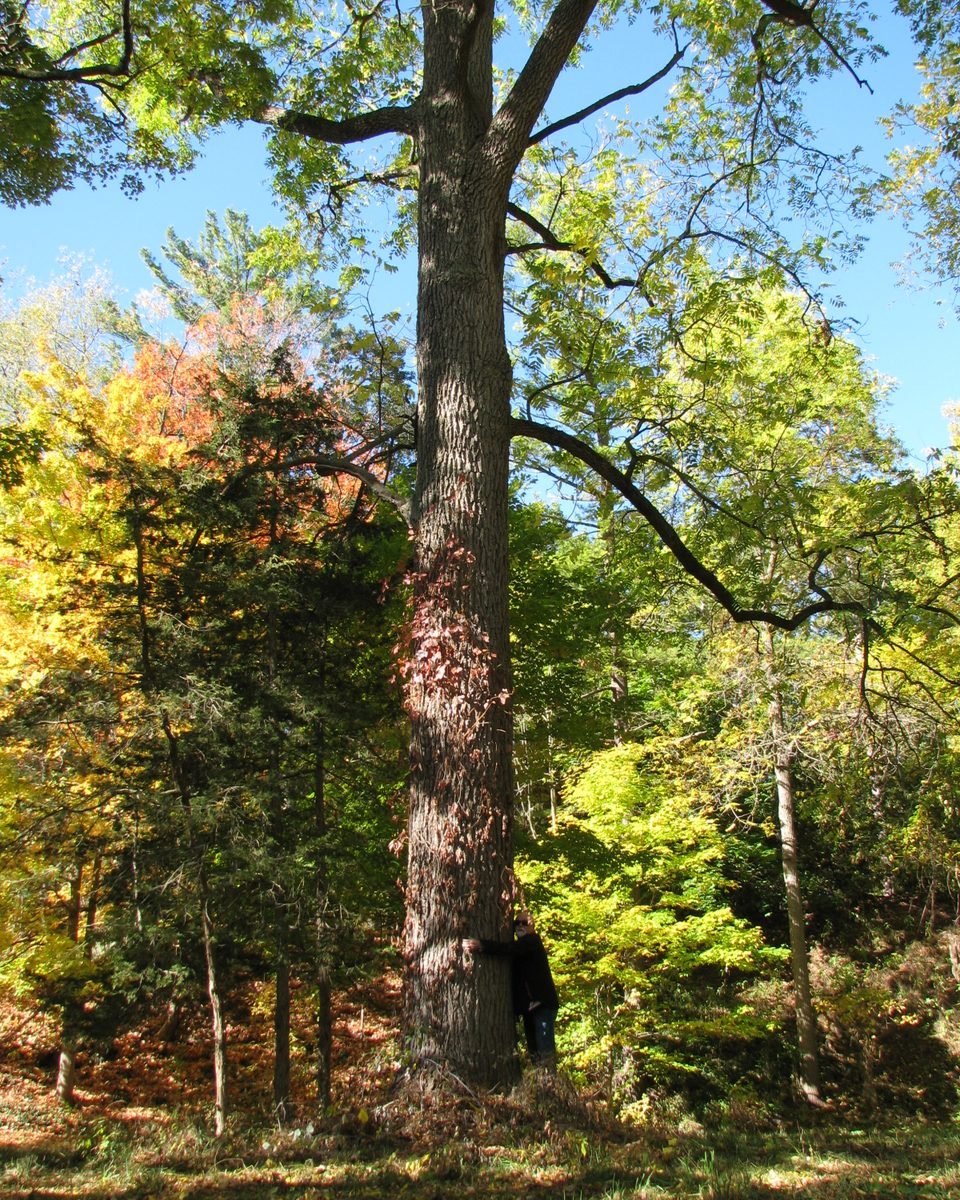
Black Walnut at the Warner Preserve
Juglans nigra
- Where
- Warner Preserve (entry by invitation only)
43°17′50.36″N 81°45′50.50″W - Diameter
- 96.5 cm
- Age
- 115 to 170 years, but could be older
- Lifetime carbon sequestration
- 6.9 metric tons of CO2
This Black Walnut is growing adjacent to the Sugar Maple, in the lower “pit” area within the Warner Preserve. Black Walnut trees can live for over 200 years. They prefer a sunny location, on moist well-drained, rich soil. Along with its sizable girth, this Black Walnut exhibits old growth characteristics with thick, dark brown to black bark, deep and narrow interlacing ridges and furrows becoming more pronounced with age. They generally have a high canopy and as they mature they produce an abundance of nuts. Walnut trees produce juglone, which is a natural compound, a form of plant toxicity which acts as a natural herbicide. This toxic substance damages plants growing under or near trees that produce juglone.
Juglone-tolerant native plants: inournature.ca
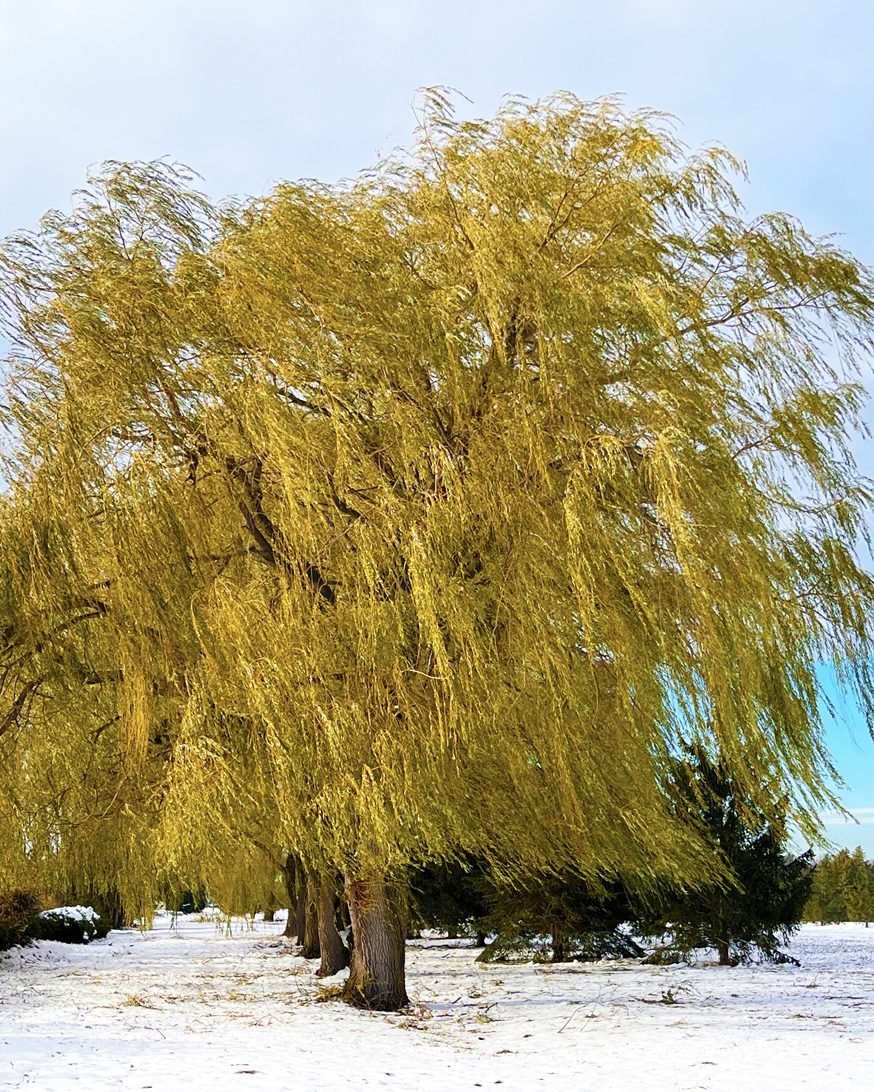
Golden Weeping Willows at Oakwood
Salix alba ‘Tristis’
- Where
- Grounds of the former Oakwood Golf Course, bordering Grand Cove Estates
43°18′59.84″N 81°44′49.25″W - Diameter
- 44 cm
- Age
- c.50 years
- Lifetime carbon sequestration
- 28 kg of CO2 per tree per year
These majestic willow trees have harboured thousands of Monarch Butterflies at rest in their dense canopy, and absorb excess surface runoff protecting the neighbouring Grand Cove Estates from flooding. They appear to have been planted in a swale to absorb excess surface water. The most common weeping willow growing in Canada is the Asian hybrid of Salix babylonica x Salix alba, often sold as Salix alba ‘Tristis’. They are very tolerant of wet sites and should not be planted in urban locations as they have aggressive root systems that can damage pipes, foundations, sidewalks and septic systems, and are susceptible to storm damage.
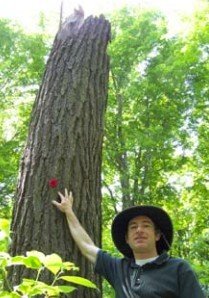
Eastern Hemlock at Morrison Dam. Photo from an Ausable Bayfield Conservation Authority newsletter article.
Eastern Hemlock at Morrison Dam Conservation Area
Tsuga canadensis
- Where
- Morrison Dam Conservation Area
43°21′35.96″N 81°27′32.03″W - Age
- 158 years
The eastern hemlock tree had withstood many storms over two centuries guarding the woods near Exeter, Ontario. Years before Irish immigrants first settled in the area, the tree was there. It kept its post for more than 200 years until a recent storm finally ended its long history. A passing hiker at Morrison Dam Conservation Area near Exeter seems to have paid a tribute to this veteran of the forest by pinning a poppy to the remains of the tree. Ausable Bayfield Conservation Authority Forestry and Land Stewardship Specialist Ian Jean discovered the poppy and the tree while walking the South Huron Trail on a recent weekend stroll. Here is how he described coming across it:
“Last evening I decided to take a walk on our Morrison Trail — something I should do more often — and stopped to admire an old hemlock that had recently fallen victim to a strong wind. Tony and Wayne (ABCA field staff) had to cut through the tree to clear the trail so, on the fresh-cut wood, I decided to count the rings. The tree had broken off about 15 feet off of the ground and I counted the 158 tree rings on the upper log which would have been at least 30 feet tall.”
It is not unusual for an eastern hemlock to reach 200 years of age. In fact, the shade-resistant species can take 300 years to mature, can reproduce for 450 years, and the oldest recorded hemlock is reported to have reached almost 1,000 years of age.
“Fittingly, someone has pinned a poppy on the bark of this fallen veteran of the forest,” Jean said. “Perhaps they had stopped and counted the rings as well.”
Perhaps the hiker who left the poppy on this tree felt it was an appropriate symbol to remember a veteran of another kind.
Where to learn more
- Shaw Woods old-growth forest research — shawwoods.ca
- Forest carbon estimators and calculators — northeastforestcarbon.org
- Black walnut — ontario.ca
- EcoMatcher — ecomatcher.com
- Calculating carbon sequestration in urban and suburban trees (PDF) — US EPA
- Trees at the University of Guelph Arboretum — arboretum.uoguelph.ca
- Old-growth forests — oldgrowth.ca